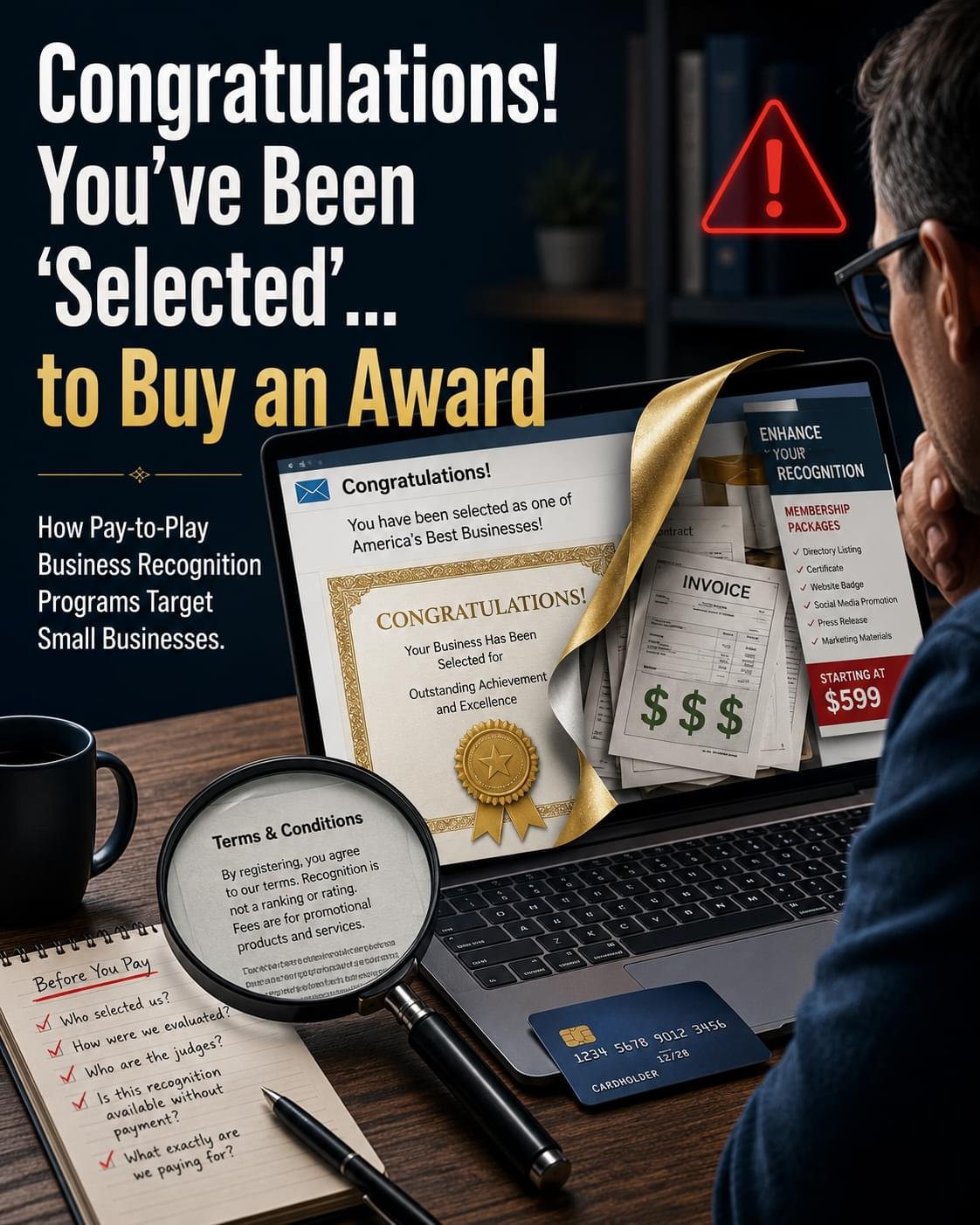
Congratulations! You've Been "Selected"... to Buy an Award...
...Now They'd Like Your Credit Card
Small business owners seem to have a target painted on their backs these days.
One week it's fake invoices. The next it's bogus domain renewals, fake Microsoft support calls, or "your website has security problems" emails. Recently, another one landed in my inbox that caught my attention because it looked far more polished than the average scam.
Brooklyn Beach Design, my Marketing and Web Design Agency, received an email announcing that we had been selected as one of the "Best Businesses in America 2026" by an organization calling itself the Worldwide Certified Business Review Board (WCBRB).
At first glance, it looked impressive.
The email congratulated us on our outstanding customer service, business leadership, vision, and commitment to excellence. It stated that our business had been reviewed and approved and invited us to accept the recognition.
Then I did what I always tell my clients to do.
I stopped reading the sales pitch and started investigating.
The Email Was Real
One thing surprised me.
The email itself was authentic.
It passed SPF and DKIM authentication, meaning it genuinely originated from the sender's domain and had not simply been spoofed.1
That is an important distinction.
Email authentication only proves who sent the message.
It says absolutely nothing about whether the offer itself is worthwhile.
Many people assume that because an email "passes security checks," the company behind it must be trustworthy.
Unfortunately, that isn't how email works.
Anyone can authenticate email from a domain they own.
Then Came the Registration Form
The email directed recipients to a Google Form to claim their recognition.
Again, don't confuse a Google Form with Google approval.
Google Forms are simply free online forms. Anyone can create one.
The registration form collected business information and then introduced several membership packages ranging from a few hundred dollars to well over a thousand dollars.
Those packages included items such as:
- Directory listings
- Certificates
- Website badges
- Social media promotion
- Marketing materials
- Business profile pages
In other words...
The "award" quickly turned into a sales presentation.
What Is a Vanity Award?
There is an important difference between an award and advertising.
A legitimate advertising program openly tells you:
"We sell promotional listings for businesses."
There is nothing wrong with that.
A vanity award takes a different approach.
It first tells you that your business has already been selected as one of the best in the country.
Only afterward does it begin offering paid packages to receive certificates, badges, directory listings, promotional exposure, and other recognition materials.
The Federal Trade Commission has warned consumers about these types of purchasable "vanity" awards because they can create the appearance of independent recognition when, in reality, they are primarily commercial products.2
Questions Every Business Owner Should Ask
Whenever you receive an unexpected award notification, ask yourself a few simple questions.
- Who nominated my business?
- Who were the judges?
- What were the scoring criteria?
- How many businesses were reviewed?
- What documentation did they examine?
- Can businesses receive this recognition without paying?
- Is this organization recognized by anyone other than itself?
Those answers should be easy to find.
If they aren't, your wallet should probably stay closed.
What We Found
After reviewing the email, the registration process, and WCBRB's public website, several things stood out.
- The email was genuine.
- The organization operates an actual website.
- The organization offers paid promotional packages.
- The recognition is tied to a commercial membership program.
- The email did not explain how Brooklyn Beach Design had specifically been evaluated.
To be fair, WCBRB states on its website that businesses must first meet its review standards before becoming eligible for recognition and that paid promotional products are optional.3
However, the unsolicited email itself contained no review report, no scoring information, no evaluator names, and no explanation of how our company had supposedly demonstrated "business leadership" or "strong vision."
Apparently they were able to determine all of that without ever speaking to us.
That's impressive.
Or convenient.
Recognition vs. Marketing
There is nothing inherently wrong with selling advertising.
Businesses buy advertising every day.
Businesses buy directory listings every day.
Businesses buy sponsored articles every day.
The problem arises when paid promotional services are presented in a way that closely resembles an independently earned honor.
Customers often assume that a badge on a website represents a rigorous, third-party evaluation.
Sometimes that's true.
Sometimes it's simply a purchased marketing package.
Protect Yourself
Before paying for any unexpected business recognition:
- Research the organization independently.
- Look for independent news coverage.
- Read both positive and negative reviews.
- Ask exactly how winners are selected.
- Ask whether recognition is available without payment.
- Read every page before providing your credit card.
Most importantly...
Don't let flattery replace due diligence.
Scammers—and aggressive marketers—understand something about human nature.
Everyone likes being told they're exceptional.
Especially if it comes with a shiny badge.
The Bottom Line
Based on our review, we believe business owners should view these emails as pay-to-play business recognition solicitations, not proof that they have received a prestigious national award.
The email itself may be authentic.
The organization may provide exactly what it advertises.
But before displaying any badge claiming your business is among the nation's best, ask yourself one simple question:
Would I have received this same recognition if I never opened my wallet?
If the answer isn't clear, neither is the value of the award.
Need a Second Opinion?
At PC-ASSIST we regularly investigate suspicious emails, scam websites, fake invoices, phishing attacks, and misleading business solicitations.
Sometimes an email is malicious.
Sometimes it's simply deceptive marketing.
Knowing the difference can save your business both money and embarrassment.
If something doesn't feel right, don't click first and ask questions later.
Ask first.
References
- National Institute of Standards and Technology (NIST). SP 800-177 Rev.1 – Trustworthy Email. https://csrc.nist.gov/pubs/sp/800/177/r1/final
- Federal Trade Commission. Look Beyond the Award When You Hire a Lawyer. https://consumer.ftc.gov/consumer-alerts/2021/12/look-beyond-award-when-you-hire-lawyer
- Worldwide Certified Business Review Board (WCBRB). Public information regarding membership, review standards and promotional services. https://www.wcbrb.com/