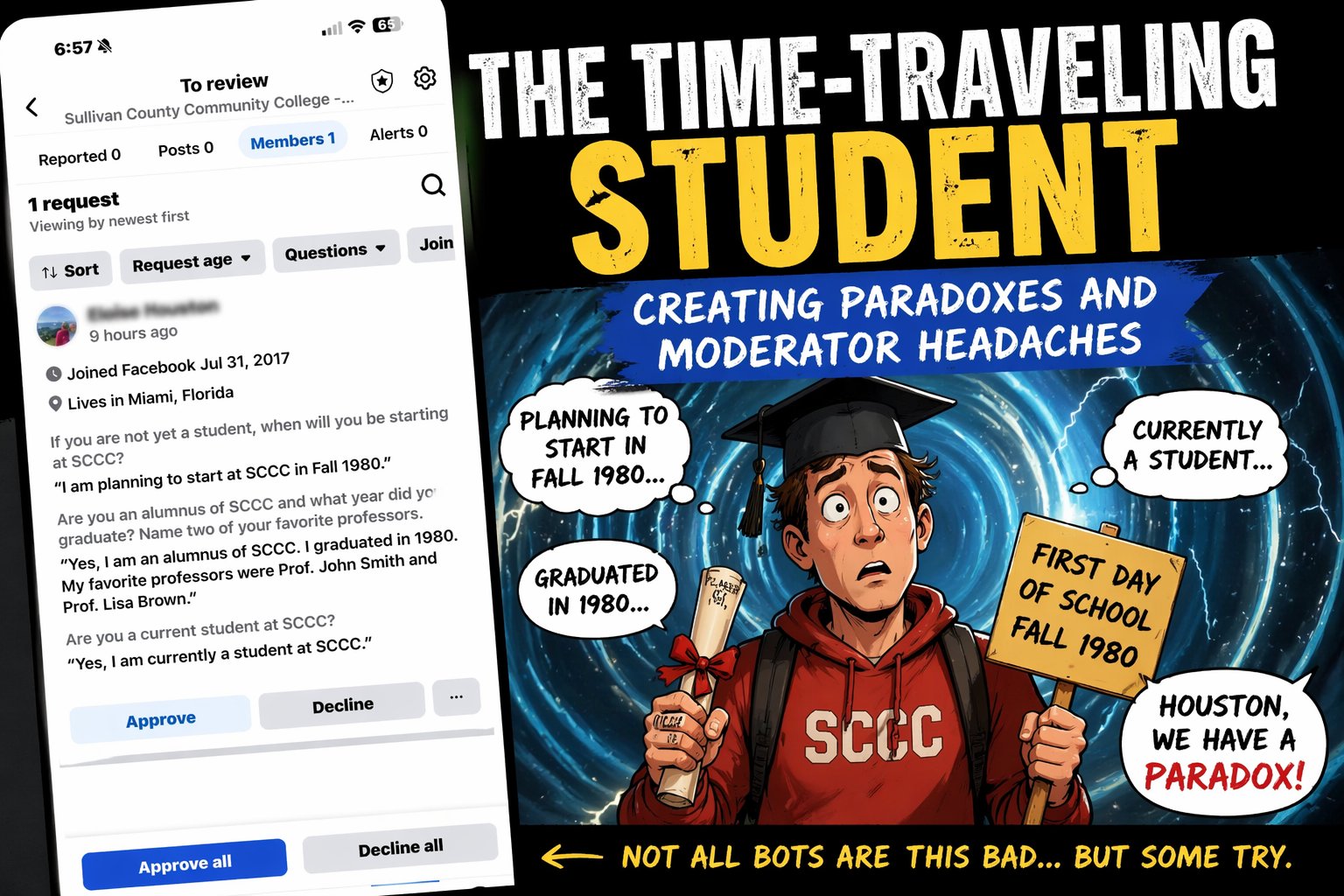
Every once in a while, the internet gifts us something truly special. Not insightful. Not useful. Just… spectacularly broken.
As a moderator for a community college alumni group, I recently came across what can only be described as a time-traveling student. And no, this wasn’t a clever joke. This was an actual membership request.
The Paradox Begins
The applicant answered the standard screening questions. That’s where things went sideways:
- “Planning to start in Fall 1980.”
- “Graduated in 1980.”
- “Currently a student.”
So to summarize:
- They haven’t started yet…
- They already graduated…
- And they’re currently enrolled.
This isn’t just inconsistent. This is a full-blown academic paradox. Somewhere, a physics professor just felt a disturbance in the space-time continuum.
Spotting the Bot (Without a PhD in Time Travel)
While this is funny, it’s also a textbook example of how low-effort bots and scripted accounts behave:
- No contextual awareness: Answers don’t align with each other.
- Pre-written responses: Likely copied from a template or generated blindly.
- Generic details: “Prof. John Smith” is basically the “password123” of academia.
These accounts aren’t trying to be clever. They’re trying to be fast—flooding groups, bypassing weak screening, and hoping something sticks.
Why This Actually Matters (Beyond the Laugh)
Behind the humor is a real security issue. Fake accounts like this are often used for:
- Spam campaigns
- Phishing attempts
- Social engineering attacks
- Data harvesting from group members
According to Meta’s Community Standards Enforcement Reports, billions of fake accounts are removed each year—many created using automated scripts that fail basic logic checks like this one.1
Similarly, the FTC warns that impersonation and fake profiles are a growing vector for scams, particularly in community groups where trust is assumed.2
Why Manual Moderation Still Wins
This is exactly why human review still matters. Automated systems can catch volume—but humans catch nonsense.
A simple set of screening questions stopped this account cold. Not because the questions were complex, but because they required something bots still struggle with:
Basic continuity of reality.
Pro Tip for Group Admins
If you manage a group, use questions that require:
- Personal context (but not sensitive data)
- Consistency across answers
- Answers that can’t be easily Googled or templated
Because while bots are getting better… they’re clearly not ready for time travel yet.
Final Verdict
This request was declined faster than a phishing email written in Comic Sans.
But it’s a perfect reminder: sometimes the biggest security wins come from simply paying attention.
References
- Meta. “Community Standards Enforcement Report.” Facebook (Meta). https://transparency.fb.com/reports/community-standards-enforcement/
- Federal Trade Commission. “Impersonation Scams.” https://consumer.ftc.gov/articles/impersonation-scams